

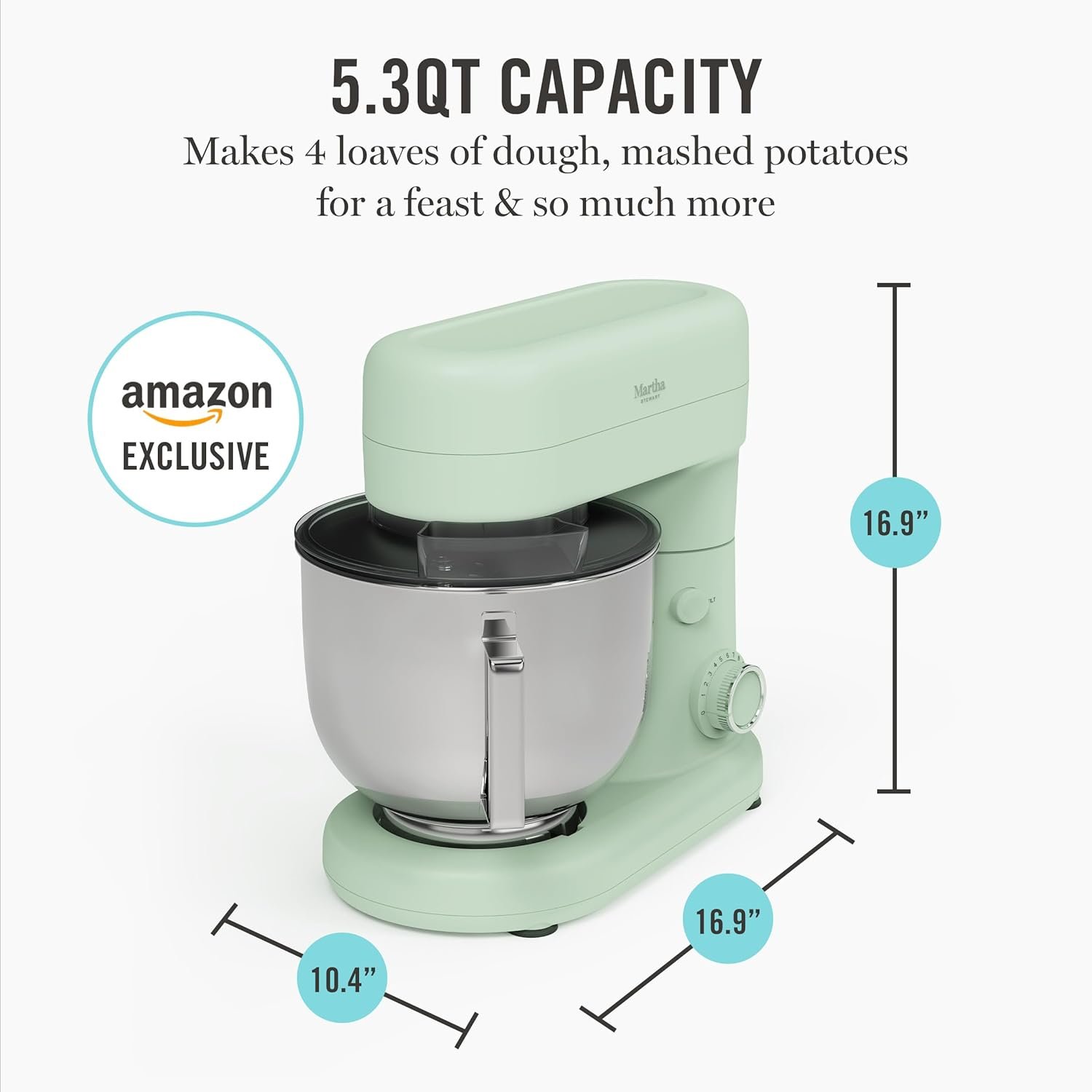
Martha Stewart 5.3QT Stand Mixer Review: A Versatile 12-Speed Mixer for Everyday Baking
Affiliate Disclosure: As an Amazon Associate I earn from qualifying purchases. This article may contain affiliate links, which means we may earn a commission from qualifying purchases at no additional cost to you.
A dependable stand mixer can make many everyday baking tasks easier, particularly when recipes require extended mixing, kneading, whipping, or repeated ingredient additions. The Martha Stewart 5.3QT Tilt Head Stand Mixer is designed as an all-purpose countertop mixer for home bakers who want a combination of useful capacity, multiple speed settings, and the essential attachments needed for a wide range of recipes.
This model features a 5.3-quart stainless steel mixing bowl, 12 speed settings, a tilt-head design, and three primary attachments: a stainless steel whisk, dough hook, and flat beater with a silicone edge. It also includes a removable splash shield to help control splatter and make adding ingredients during mixing more convenient.
With a design that emphasizes both functionality and countertop appearance, this Martha Stewart mixer could be an appealing choice for cookies, cakes, bread dough, frosting, whipped cream, mashed potatoes, and similar home kitchen projects.
In this review, we’ll examine its design, bowl capacity, attachments, speed control, usability, and the types of users who may benefit most from it.
Quick Overview
The Martha Stewart stand mixer is designed around the features most home bakers regularly need.
Key specifications include:
- 5.3-quart stainless steel mixing bowl
- 12 adjustable speed settings
- Tilt-head mixer design
- Stainless steel whisk
- Dough hook
- Flat beater with silicone edge
- Removable splash shield
- Pour opening for adding ingredients
- Non-skid feet
- Adjustable rotary speed control
- 660-watt rated power
- Multiple color options
Rather than limiting the mixer to basic cake batter preparation, the combination of attachments and speed settings makes it suitable for several different mixing techniques.
Design and Build
One of the first things that stands out about this mixer is its traditional tilt-head configuration.
The mixer head can be raised to provide easier access to the bowl and attachment area. This design makes several common baking tasks more convenient, including installing attachments, removing the mixing bowl, scraping ingredients from the bowl, and adding ingredients before mixing.
Once the required attachment is installed, the mixer head can be lowered back into position.
The mixer also uses a relatively straightforward rotary control system rather than a complicated digital interface. For users who prefer appliances that can be operated without menus, screens, or numerous buttons, the physical speed dial keeps operation simple.
A stable base with non-skid feet is another useful feature because stand mixers can experience movement when working with heavier mixtures. Proper placement on a flat, secure countertop remains important, particularly when kneading thicker dough.
The Martha Stewart mixer is also available in several colors, making it easier to coordinate with different kitchen styles.
Spacious 5.3-Quart Stainless Steel Bowl
The included 5.3-quart bowl provides enough capacity for many typical home baking recipes without turning the appliance into an excessively large commercial-style mixer.
Stainless steel is particularly practical for a mixing bowl because it does not require the same careful handling as glass and is suitable for a broad range of ingredients.
The bowl can accommodate everyday recipes such as:
- Cookie dough
- Cake batter
- Brownie mixtures
- Bread dough
- Pizza dough
- Whipped cream
- Egg whites
- Frosting
- Mashed potatoes
- Muffin mixtures
The capacity should be especially useful for households that regularly prepare standard or moderately large batches.
However, capacity alone does not mean every recipe should fill the entire bowl. Dense bread dough places considerably more resistance on a mixer than whipped cream or cake batter, so batch size should always be adjusted according to the recipe and mixer instructions.
12 Speed Settings
A major advantage of this model is its 12-speed control system.
Different ingredients require very different mixing speeds. Starting every recipe at high speed can send dry ingredients outside the bowl, while using a low speed for whipping cream may take unnecessarily long.
The wider speed range allows the mixer to transition between gentle folding and faster whipping.
Lower speeds can be useful when incorporating flour, chocolate chips, nuts, fruit, or other ingredients that should not be aggressively mixed.
Medium speeds are suited to many everyday tasks such as mixing batters, creaming ingredients, and using the flat beater.
Higher settings are more appropriate when using the whisk to incorporate air into ingredients such as cream or egg whites.
Starting slowly and gradually increasing the speed is generally the most controlled approach, particularly when dry ingredients are present.
Three Useful Mixing Attachments
A stand mixer becomes much more versatile when the appropriate attachment can be selected for each recipe. This Martha Stewart model includes three attachments covering the most common home baking techniques.
Stainless Steel Whisk
The whisk is intended for mixtures where incorporating air is important.
Typical applications include:
- Whipped cream
- Egg whites
- Meringue-style preparations
- Light frostings
- Aerated mixtures
The combination of the whisk attachment and higher speed settings allows the mixer to handle tasks that would otherwise require extended manual whisking.
Dough Hook
The dough hook is designed for heavier mixtures such as bread and pizza dough.
Instead of repeatedly kneading by hand, the rotating hook works the dough inside the bowl.
It can be helpful for recipes such as:
- Homemade bread
- Pizza dough
- Dinner rolls
- Similar yeast-based doughs
Dense dough is one of the more demanding jobs for any stand mixer, so recipes should remain within the manufacturer’s recommended quantities and operating guidelines.
Flat Beater with Silicone Edge
The flat beater is likely to become the attachment used most frequently.
It can handle a broad range of everyday recipes, including:
- Cake batter
- Cookies
- Brownies
- Frosting
- Mashed potatoes
- General mixing tasks
A particularly useful detail is the silicone edge incorporated into the beater. Its purpose is to improve contact with ingredients near the sides of the bowl while mixing.
Manual scraping may still occasionally be necessary depending on the recipe, but this design can reduce the amount of ingredient that remains around the bowl edges.
Removable Splash Shield
Adding flour or powdered ingredients to a moving mixer can quickly create a mess.
The included removable splash shield provides a physical barrier around the upper portion of the mixing bowl to help limit splashing and airborne dry ingredients.
It also incorporates an opening that allows ingredients to be added while the shield remains installed.
This is particularly useful when a recipe requires gradual additions, such as incorporating flour into batter or slowly adding ingredients to frosting.
The splash shield can also be removed when it is not required.
Ease of Use
The overall operating process is relatively straightforward.
Raise the tilt head, lock the mixing bowl into place, install the appropriate attachment, lower the mixer head, and choose the required speed.
Because the mixer offers dedicated attachments rather than requiring one attachment to perform every task, choosing the correct accessory is important.
For example, the whisk is more appropriate for aerating cream, while the flat beater is better suited to cookie batter. The dough hook is intended for kneading rather than general mixing.
The tilt-head mechanism also improves accessibility when changing attachments or removing the bowl.
For first-time stand mixer users, beginning at a lower speed is particularly important. It provides greater control and reduces the chance of dry ingredients being thrown from the bowl.
Baking Performance and Versatility
On paper, the combination of a 660-watt rated motor, 12 speeds, 5.3-quart bowl, and three attachments gives this mixer a useful level of versatility for a residential kitchen.
It is important, however, not to confuse motor wattage alone with overall mixing capability. Factors such as gearing, attachment design, recipe consistency, and batch size also influence how a stand mixer performs.
For everyday home use, this model is configured to handle the core categories people typically expect from a stand mixer: mixing, beating, whipping, and dough preparation.
Someone primarily making cakes and cookies can use the flat beater for most recipes, while users who regularly make bread have the dedicated dough hook available.
The whisk expands the mixer’s usefulness into desserts and preparations requiring aeration.
This makes the appliance more flexible than a single-purpose mixer.
Who Is This Mixer Best For?
The Martha Stewart 5.3QT Stand Mixer appears particularly well suited to home bakers who want one countertop appliance for multiple baking tasks.
It may be a strong fit for:
- Home bakers making cakes and cookies regularly
- People beginning to experiment with homemade bread
- Families preparing medium-sized batches
- Users who want multiple speed settings
- Bakers who appreciate a tilt-head design
- Anyone who wants a stainless steel mixing bowl
- Users who prefer included essential attachments rather than buying them separately
It could also work well as a first stand mixer for someone moving away from a handheld mixer.
Things to Consider Before Buying
Despite its versatility, there are a few practical considerations.
Counter Space
A stand mixer occupies permanent or semi-permanent countertop space. Check the available counter area and overhead cabinet clearance, particularly because the mixer head needs room to tilt upward.
Bowl Capacity
The 5.3-quart bowl is suitable for many household recipes, but people routinely preparing very large quantities may prefer a higher-capacity mixer.
Dense Dough
Heavy bread dough places more strain on a mixer than ordinary cake batter. Always follow the recommended batch sizes and operating instructions when preparing thick mixtures.
Attachment Needs
The included whisk, dough hook, and flat beater cover the core mixing jobs most home bakers need. Buyers looking for specialized accessories should determine whether additional compatible attachments are available for their intended recipes before purchasing.
Pros and Cons
Pros
- Generous 5.3-quart stainless steel bowl
- 12 speed settings provide good mixing control
- Tilt-head design simplifies bowl access
- Includes three essential mixing attachments
- Dough hook supports homemade bread preparation
- Stainless steel whisk is useful for whipping and aerating
- Flat beater includes a silicone edge
- Splash shield helps limit mess
- Pour opening makes ingredient additions easier
- Suitable for a broad variety of everyday baking tasks
- Multiple available colors
Cons
- Requires more countertop and storage space than a hand mixer
- Large or especially dense dough batches should be prepared within recommended limits
- Specialized accessories beyond the included attachments may need to be sourced separately
- A stand mixer may be unnecessary for people who bake only occasionally or prepare very small recipes
Final Verdict
The Martha Stewart 5.3QT Tilt Head Stand Mixer offers a practical combination of capacity, attachment variety, and speed control for everyday home baking.
Its 5.3-quart stainless steel bowl is large enough for many common household recipes, while the 12 speed settings provide flexibility for techniques ranging from gentle ingredient incorporation to faster whipping.
The included whisk, dough hook, and flat beater with silicone edge cover the three major tasks expected from a versatile stand mixer: whipping, kneading, and general mixing.
The removable splash shield and tilt-head mechanism also contribute to a more convenient workflow, especially when ingredients must be added gradually or attachments need to be changed between recipes.
This mixer is best viewed as a multifunctional home baking appliance rather than specialized commercial equipment. For home cooks preparing cakes, cookies, bread, frostings, whipped desserts, and similar recipes, the feature set offers considerable flexibility in a single machine.
If your priority is a stand mixer with a spacious stainless steel bowl, several speed options, and the essential accessories included from the start, the Martha Stewart 5.3QT Stand Mixer deserves consideration.
Check current availability and product details on Amazon.
Product specifications and availability may change over time. Always review the current product listing and manufacturer information before purchasing.
Affiliate Disclosure: As an Amazon Associate I earn from qualifying purchases.
🛒 View at Amazon(affiliate link)